

Chong Ng has been at the forefront of offshore wind innovation for more than two decades.
He joined the Offshore Renewable Energy (ORE) Catapult (then known as the National Renewable Energy Centre) in 2009 and progressed through a series of technical and leadership roles, contributing to the development of some of the world’s most advanced offshore wind research and testing facilities at the time, before going on to lead the organisation’s Test and Validation team.
Now as Senior Associate Director – Applied Research, he leads a team of more than 70 PhD researchers, engineers, and specialists delivering applied research across digital and robotics, turbine blades, powertrains, and electrical infrastructure.
Chong has also played a leading role in building international collaborations and strategic partnerships. He is a board member of The Association of European Renewable Energy Research Centres and holds honorary professorships at both University of Warwick and Northumbria University, where he contributes to strategic research and industry collaboration in offshore renewable energy.
Now he has a new challenge.
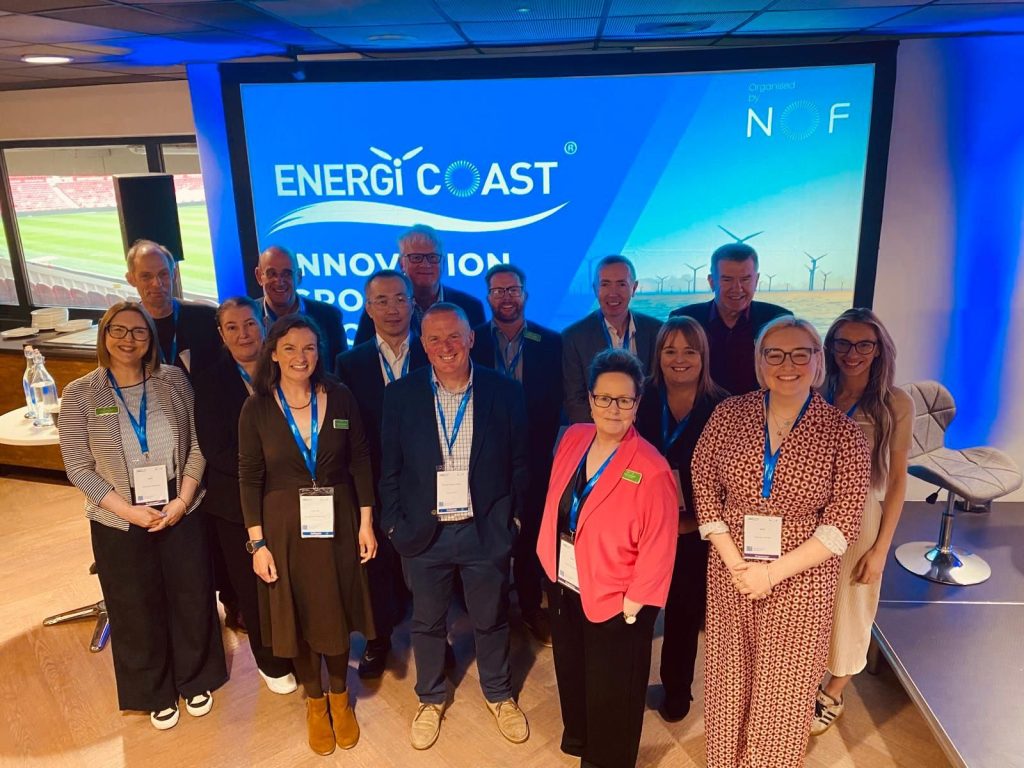
Chong has taken up the position of Innovation Group Lead for Energi Coast, North East England’s offshore wind cluster, following Professor Simon Hogg’s retirement from the role this spring. The Group brings together industry, academia and regional partners to focus on translating innovation into real-world impact.
From robotics to turbine design, we talk to Chong about what innovation means in offshore wind… and why North East England is poised to benefit from this “once-in-a-generation” opportunity.
Tell us about your new role as Energi Coast Innovation Group Lead…
Over the last ten years, I’ve spent a lot of time engaging with the offshore wind sector internationally, particularly across Asia. I’ve seen some very successful industrial clusters emerge. Interestingly, many of those success stories were built on lessons learned from the UK’s early experience and leadership in offshore wind.
At the same time, having lived in the North East for nearly 30 years, I’ve always felt there is a significant opportunity for the region to play a much bigger role in shaping the future direction of the sector globally. Therefore, when Professor Hogg announced his retirement and I was approached about taking on the role, I saw it as an opportunity to bring together my international experience, industry connections and strategic perspective to help strengthen the region’s long-term innovation, industrial capability and competitiveness in offshore wind.
Innovation is no longer just about renewable energy. It’s increasingly about industrial competitiveness, energy security, productivity, and long-term economic resilience. If we lose focus on this, we risk missing a once-in-a-generation industrial opportunity.
I’d like to use my experience to help ensure the North East brings together industry, innovation, infrastructure and skills into a globally competitive ecosystem.
You’ve been working in the offshore wind sector for two decades. What have been the most significant changes in the sector, from your perspective?
The offshore wind industry has moved into a different phase of development. If we roll back to 10 to 15 years ago, it was about proof of concept. It was about telling everyone that you had good technology to showcase.
Now the industry is entering a new phase focused on industrial scalability, reliability and long-term operational performance. As turbines and wind farms continue to increase in scale, investment levels rise, ensuring reliability, availability and long-term performance becomes critically important. That is one of the areas that really excites me.
The next phase of offshore wind will not be defined purely by turbine size or deployment volume. It will be shaped by which countries, regions or organisations can combine innovation, industrial capability, reliability, digitalisation and supply chain resilience into a globally competitive ecosystem.
What about the future? What are the challenges and opportunities as the offshore wind sector continues to evolve?
In turbine design, there are still gaps to fill. A lot of technology from other industries is being used in turbines.
In addition, there is the challenge of ensuring that wind turbines deployed far away from shore can still be effectively repaired and maintained. This means that the robotics industry needs to build its interest in offshore wind. But to develop effective robotic technology, we also need advanced sensing technology, data and autonomous decision-making capability, alongside solutions that are dedicated to offshore wind. For example, we’ve all seen videos of robotic dogs or humanoid robots demonstrating impressive dynamic movement on YouTube; however, at the end of the day, they are still just robotic platforms. Their real value depends on the applications, intelligence and offshore-specific capability we can build around them.
ORE Catapult has a lot of experience in these areas and can lead on technology development.
At a regional level, North East England is very strong in supporting the full subsea cable life cycle. The region already has strong digital capability. However, there remains a significant opportunity to strengthen robotics and autonomous systems for offshore O&M. So, we could potentially scale this capability up to a higher level.
How is North East England positioned in the energy transition?
This is a once in a generation opportunity. It represents the biggest industrial transformation we have seen since the Industrial Revolution.
Think about the electric vehicle. If you want to decarbonise transport, you need electric vehicles, and you need hydrogen for commercial transportation; and the hydrogen has to be green.
And if we are going to be a leading nation in AI, we need large-scale data centres, which require electricity.
If you look at all this together, there’s a need for energy diversification. We can’t just rely on one source, such as gas. We need a resilient and diversified energy system. Offshore wind will be one of the central pillars of that future energy system, together with nuclear and other low-carbon technologies.
So where is North East England in this picture? The region is emerging as one of the most strategically important offshore wind hubs in Europe.
Earlier this year, The Crown Estate announced the next leasing round could accommodate a capacity of around 6GW or more of new capacity, with a significant proportion expected to be concentrated around the North East of England. We have the industrial heritage, engineering capability, internationally recognised subsea expertise, strong port infrastructure and leading universities. Collectively, those strengths position the region extremely well for the next phase of offshore wind growth.
Through Energi Coast, we bring all of these players together.
What impact could the region have on an international scale?
We shouldn’t just think about participating in offshore wind growth, we should position ourselves to help shape the future direction of the sector globally.
We already have the foundations. The challenge now is converting those strengths into long-term global leadership, industrial competitiveness and sustained economic value for the region.
Find out more about the Energi Coast Innovation Group here.
Learn about the work of the ORE Catapult here.